
About MateIntent Notebook
A specialized technical journal exploring the real-world mathematical and geometric constraints of discrete mechanical assemblies.

Documenting Isolated Rigidity Over Parametric Variety
MateIntent Notebook is an independent engineering archive dedicated to studying mechanical mate topologies within individual solid assemblies. Rather than cataloging endless parametric variations or automated family tables, this publication investigates the exact kinematic behavior, contact mates, and degree-of-freedom resolution of a single, well-defined physical assembly.
The Single-Model Paradigm
Modern CAD education frequently emphasizes master modeling, multi-body top-down pipelines, and expansive design tables. However, true assembly failures and mate diagnostic errors occur in the minutiae: over-constrained concentric mates, floating tangent planes, and undetected micro-motions. We isolate one mechanical instance and trace its constraints down to the coordinate zero.
Quiet Publishing: No Comments, No Social Channels
MateIntent Notebook maintains a distraction-free static distribution format. There are no user accounts, no comment sections, no algorithmic reaction counters, and no third-party tracking feeds. The goal is pure archival clarity for practicing mechanical designers, stress analysts, and CAD engineers.
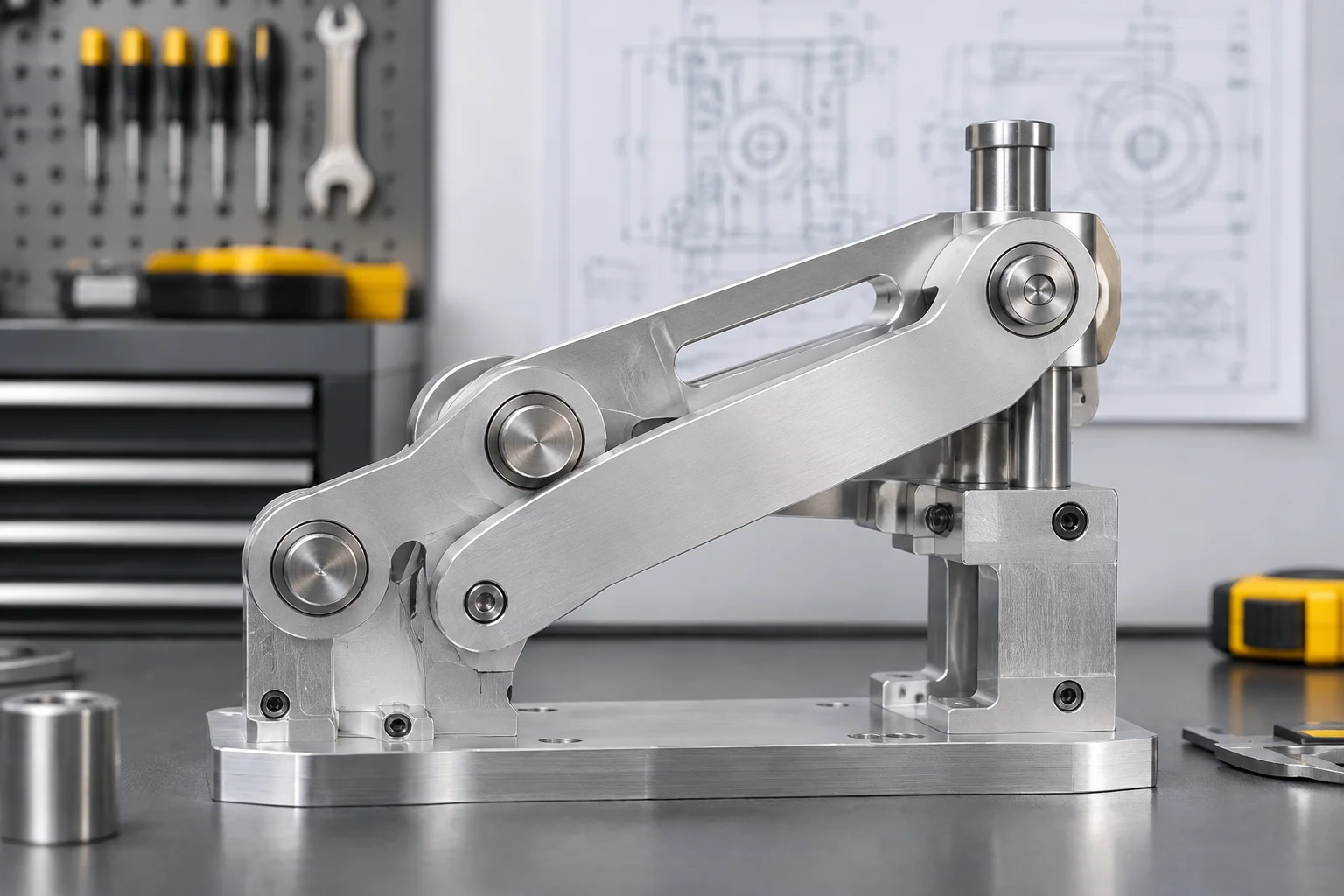
Reference test rig showing rotational locks and coaxial mating surfaces.
Standards of CAD Constraint Verification
Kinematic Determinacy
Evaluating when assemblies transition between under-constrained mechanism conditions and fully defined static structures without relying on redundant relations.
Solver Convergence
Documenting mate solver anomalies, numerical tolerance roundoffs, and flipped mate alignments when rebuild cycles run on complex multi-link fixtures.
Peer Review Protocols
Establishing structured checklist workflows for CAD teams to audit coordinate origins, subassembly grouping, and mate order prior to drawing release.